Types of Pressure Switches: How to Pick the Right One
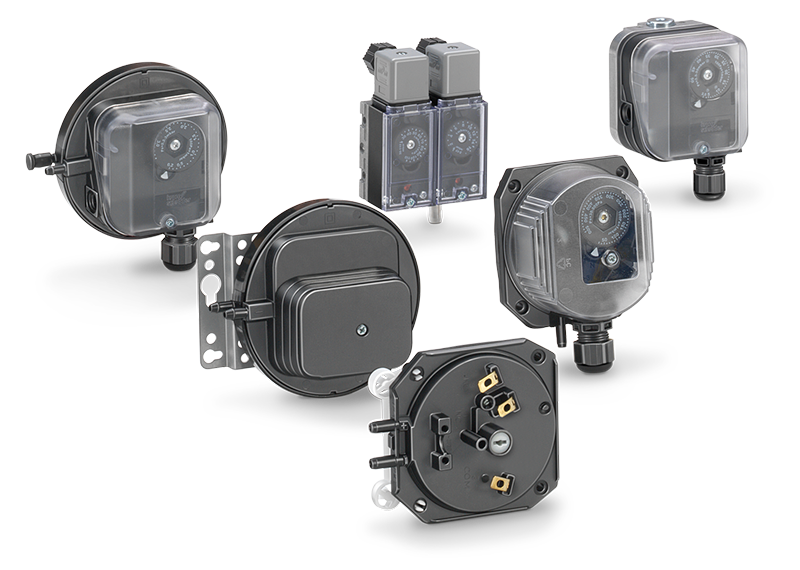
When it comes to combustion system safety, pressure switches are arguably the most important component to get right. Whether you’re setting up a new system, retrofitting an existing one, or just tracking down a replacement, this guide walks through everything you need to evaluate to make sure you land on the right switch for your application.
What is a Pressure Switch?
Pressure switches are safety devices required by NFPA code on gas lines and combustion air systems. They monitor pressure in real time and shut your system down the moment conditions drift outside a safe range. In most combustion systems, you’ll have three: a high gas pressure switch, a low gas pressure switch, and a low air pressure switch — though the exact configuration depends on your process.
The problem is that a “pressure switch” is not a one-size-fits-all product. There are about 10 to 12 selection variables to work through before you have the right part for your application. Get one of those variables wrong and you could end up with a switch that fails to protect your system, gets damaged by your own operating conditions, or doesn’t meet the approval requirements for your location.
Common Pressure Switches and Their Applications
Honeywell/Kromschröder DG Series
A globally recognized standard in combustion safety, the DG series is the go-to for commercial and lighter industrial applications where gas pressures stay under 7 PSI.
Common applications:
- Commercial boilers
- Food ovens and dryers
- HVAC and make-up air units
- Light manufacturing
SCC Inc. QPx32 Series
A modern, North American-focused option that shares a similar application range as the DG but stands out for hydrogen compatibility, gold contacts standard, and flexible wiring options.
Common applications:
- Similar commercial and light industrial applications as the DG
- Applications requiring hydrogen compatibility
- Systems running at 24V where gold contacts matter
Ashcroft B-Series
Built for the demands of heavy industry, the Ashcroft B-Series handles significantly higher pressures and harsher environments than the other two brands.
Common applications:
- Steel mills
- Paper mills
- Oil and gas / refineries
- Applications requiring explosion-proof enclosures (NEMA 4X)
Which Pressure Switch Do You Need?
There are a lot of factors that go into finding the right pressure switch for your application. Here’s everything you need to consider.
1. Gas or Air Pressure Switch?
Pressure switches are designed and certified for specific media — either fuel gas (natural gas, propane, etc.) or combustion air. You cannot substitute one for the other. Make sure the switch you select is rated for what it’s actually going to be monitoring.
Popular Switches with both gas and air options available:
- Honeywell/Kromschröder DG Series
- SCC Inc. QPx32 Series
- Ashcroft B-Series
2. Manual Reset vs. Automatic Reset Pressure Switches
When a pressure switch trips, what happens next depends on whether it’s set up for manual or automatic reset.
An automatic reset switch will restore itself to a safe state once pressure returns to an acceptable range. If the pressure drifts back in bounds, the system can restart on its own. This is the more common configuration and typically runs about 10% less expensive than its manual counterpart.
A manual reset switch locks out and stays locked out. Someone has to physically walk over and push a button to acknowledge the fault before the system can restart. That extra step forces your team to be aware that a safety event occurred rather than just finding out the burner tripped for an unknown reason.
When to use automatic reset: The switch is in a difficult-to-access location — up on a third floor, tucked behind equipment, or somewhere that’s genuinely inconvenient to reach every time a trip occurs.
When to use manual reset: You want a forced acknowledgment that a safety issue happened, particularly in environments where undetected pressure events are a concern. Both options are fully NFPA compliant.
3. Pressure Rating
Pressure rating is the maximum pressure the switch can be exposed to without sustaining damage. This is different from your operating pressure, it’s the safety ceiling.
Why does it matter? Because if your pressure regulator fails, everything downstream gets hit with whatever pressure is sitting upstream. Your switch needs to be sized to survive that scenario.
For the Honeywell/Kromschröder DG and SCC QPx32 series, the maximum operating pressure is 7 PSI. The failure pressure (the point where you risk damage) is around 8.5 to 15 PSI depending on the model. These are well-suited for commercial and lighter industrial applications where upstream gas pressure stays under that threshold.
The Ashcroft B-Series operates in a different class entirely, with pressure ranges up to 3,000 PSI. If your facility has incoming gas pressures of 20 to 30 PSI or higher — typical in steel mills, paper mills, oil refineries, or other heavy industrial settings — Ashcroft is likely the right direction.
4. Pressure Set Point Range
Your pressure set point is the specific pressure value the switch is calibrated to trip at. A low pressure switch trips when pressure drops below that value; a high pressure switch trips when pressure rises above it. That set point is determined by your burner’s normal operating pressure, and whoever is commissioning the system typically dials it in on-site.
Before you can select a switch, you need to know roughly what pressure range your system operates in because each model only covers a specific window. A switch with a range of 0.2 to 2.4 inches W.C. won’t be useful if your system operates at 40 inches W.C., and vice versa.
A note on units: pressure in combustion systems is expressed in different units depending on the application, which can make this confusing. Lower-pressure commercial and light industrial systems, like a food oven or a dryer, are typically measured in inches of water column (inches W.C.) or millibar (mbar).
These are very small units; 1 PSI is roughly equal to 28 inches W.C. Heavier industrial systems operate at higher pressures and are measured in PSI. If you’re not sure which unit applies to your system, check your burner documentation or ask your equipment supplier.
With that in mind, each brand offers a range of models to cover different set point windows. The
- Honeywell/Kromschröder DG and SCC QPx32 series cover lower-pressure applications, from fractions of an inch W.C. up to around 4 PSI, making them the right fit for commercial and lighter industrial systems.
- The Ashcroft B-Series covers a much wider range, with set points available up to 3,000 PSI, which is why it’s the go-to for heavy industrial environments like steel mills, paper mills, and oil refineries where operating pressures are significantly higher.
5. High Pressure vs. Low Pressure
Most combustion systems require multiple pressure switches — typically a high gas pressure switch, a low gas pressure switch, and a low air pressure switch. If you’re ordering multiple different burners at once, pay close attention to the models you are ordering.
With the Honeywell/Kromschröder DG and Ashcroft B-Series, high and low pressure are distinct part numbers. With certain SCC QPx32 models (the QPB32 automatic reset series), the same switch can function as either high or low depending on how you wire it, which gives you more flexibility if you’re stocking parts or outfitting a system with multiple switches. Honeywell/Kromschröder DG also offers a single switch option that can be wired for either high or low, alongside their default pre-wired switches.
6. Vented vs. Ventless Pressure Switches
Pressure switches contain a diaphragm. In a failure scenario where that diaphragm ruptures under too much pressure, the gas inside needs somewhere to go. How your switch handles that is the vented vs. ventless question.
A vented switch has a port where escaping gas can be routed to a safe location, typically outdoors or to a designated vent. This adds an installation step (you need to run that vent line), but it reduces risk if the diaphragm fails. Vented switches also tend to carry slightly higher pressure ratings.
A ventless switch is simpler to install. No vent line required. It’s preferred by many facilities for that reason. The tradeoff is a slightly lower pressure rating and different risk profile in a failure event.
From a code standpoint: NFPA in the United States does not require vented switches. Canadian (CSA) and European (CE) standards generally do. If you’re shipping equipment or have facilities operating under those codes, plan accordingly.
7. Connection Size and Type
Two connections to think about here.
The process connection (gas or air side) is typically 1/4″ NPT for the DG and QPx32 series, and 3/4″ NPT for the Ashcroft B-Series. Make sure whatever you’re threading the switch onto matches.
The electrical conduit connection is generally 1/2″ threaded across all three brands. For the SCC QPx32, note that the conduit connection is designed for flexible conduit only. Rigid metal conduit is not permitted.
Neither of these will typically be the deciding factor in brand selection, but you need to account for them in your installation planning.
8. Temperature Rating
Every pressure switch has an ambient temperature range. The temperature of the air around the switch, not the gas or air passing through it. This matters more than people often expect, because a valve train mounted above an oven or on the roof of a building can see significantly elevated ambient temperatures.
Most Honeywell/Kromschröder and SCC switches are rated to 140°F ambient. The Ashcroft B-Series is rated to 150°F. In most indoor industrial environments, this is sufficient.
Process temperature (the temperature of the gas or air itself passing through the line) can be considerably higher, up to around 300°F, and most switches handle this without issue because the electrical components are separated from the process line.
9. Indicator Lights
An optional but often useful feature, indicator lights provide visual status at the switch — typically green for a safe state, red for a tripped condition. This is especially practical when switches are located in areas that aren’t checked constantly; a technician can read status from across the room.
The Honeywell/Kromschröder DG series includes indicator light options as a configuration choice. With SCC QPx32 switches, indicator lamps are a separate accessory you purchase and wire in. Ashcroft B-Series switches offer a pilot light option on 400-Series enclosures.
NFPA does not require indicator lights. Certain international codes may. If you’re uncertain, check your specific approval requirements.
10. Safety Approvals and Certifications
The approvals stamped on a pressure switch tell you what codes and standards it’s been tested and certified to meet. Your insurance carrier and local code authorities will care about this.
In the United States, look for UL (Underwriters Laboratories) and FM (Factory Mutual) approvals. In Canada, CSA (Canadian Standards Association) or cUL. In Europe, CE. Other regional approvals exist as well (AGA in Australia, EAC for the Eurasian Customs Union).
All three brands covered in this article carry UL and FM approvals on applicable models. The Honeywell/Kromschröder DG series additionally carries EU certification including CE, GAR, and EN 1854 compliance, along with SIL 3 and Performance Level e ratings for functional safety applications.
11. Enclosure Rating (NEMA/IP)
NEMA ratings describe how well the switch enclosure protects against environmental factors. For most indoor, dry industrial applications, a basic enclosure is fine. For outdoor applications, wet environments, or washdown areas, you’ll want NEMA 4 (watertight) at minimum.
The Honeywell/Kromschröder DG and SCC QPx32 series both carry NEMA 4 / IP65 ratings, which covers most outdoor and moisture-exposed applications. The Ashcroft B-Series offers NEMA 4X (explosion-proof) on its 700-Series enclosures. This is required in environments where flammable gases may be present in the ambient air outside the switch. You’ll encounter this requirement most often in oil and gas applications.
In Europe, IP ratings are used instead of NEMA. IP65 is the functional equivalent of NEMA 4.
12. Voltage
Most pressure switches used in combustion systems run at 24V, 115V, or 230V. The Honeywell/Kromschröder DG and SCC QPx32 series handle a wide voltage range and are wired differently depending on the voltage in use. For the Ashcroft B-Series, you’ll typically specify voltage at the time of ordering.
One thing to be aware of as more facilities shift to 24V systems: lower voltages require gold-plated contacts for reliable switching. Standard switches use silver contacts, which aren’t ideal at lower voltages. The SCC QPx32 series includes gold contacts as standard on all models — a meaningful differentiator if you’re operating at 24V.
PRESSURE SWITCHES AT-A-GLANCE
Honeywell/Kromschröder DG Series Pressure Switches
The DG series is a diaphragm-based pressure switch designed for monitoring gas and air pressures in commercial and light industrial combustion systems. It’s available in a wide range of models covering positive, negative, and differential pressure applications.
- Media: Natural gas, propane, LPG, biogas, flue gas, air
- Pressure set point range: 0.5 mbar to 500 mbar (approximately 0.007 to 7.25 PSI) depending on model
- Maximum operating pressure: Up to 600 mbar (approximately 8.7 PSI) depending on model
- Reset options: Automatic and manual reset models available
- Enclosure rating: IP 54 or IP 65 depending on model
- Ambient temperature range: -20°C to +80°C (-4°F to +176°F) depending on model
- Electrical connection: Screw terminals with M16 cable gland or plug/socket
- Approvals: UL, FM, CSA, CE, AGA, EAC, SIL 3, Performance Level e
Download the Honeywell/Kromschröder DG Series Spec Sheet
SCC Inc. QPx32 Series
The QPx32 is a compact, modern gas pressure switch designed specifically for the North American market. It covers a range of low-pressure applications and is notable for its hydrogen compatibility, standard gold contacts, and NEMA 4 outdoor rating straight out of the box.
- Media: Natural gas, propane, butane, hydrogen, biogas, air (1/4″ NPT connection); dry air only (1/8″ NPT connection)
- Pressure set point range: 0.2 in W.C. to 200 in W.C. (approximately 0.007 to 7.3 PSI) depending on model
- Maximum operating pressure: 7 PSI ventless; 15 PSI vented
- Reset options: Automatic reset (QPB32) and manual reset (QPH32 high, QPL32 low) models available
- Enclosure rating: NEMA 4 (IP66)
- Ambient temperature range: -40°F to 140°F for most models; -10°F to 140°F for QPx32.002 and QPx32.004 models
- Electrical connection: 1/2″ NPSM flexible conduit only
- Contacts: Gold plating over silver alloy, standard on all models
- Approvals: cULus, FM, CSA C22.2
Download the SCC Inc. QPx32 Series Spec Sheet
Ashcroft B-Series
The Ashcroft B-Series is a heavy-duty pressure switch line built for demanding industrial environments. It covers a dramatically wider pressure range than the other two brands and is available with explosion-proof enclosures for hazardous area installations.
- Media: Compatible with a wide range of gases and liquids depending on diaphragm material selection (Buna-N, Viton, Teflon, 316 stainless steel, Monel)
- Pressure set point range: Vacuum to 3,000 PSI (pressure); 0 to 600 PSI differential; 1,000 to 7,500 PSI hydraulic
- Maximum operating pressure: Up to 12,000 PSI proof pressure depending on model
- Reset options: Standard, manual reset, and dual-switch element models available
- Enclosure rating: NEMA 4X (B4/D4 series); NEMA 7/9 explosion-proof (B7/D7 series)
- Ambient temperature range: -20°F to 150°F (-28°C to 65°C)
- Process temperature range: 0°F to 300°F depending on diaphragm material
- Pressure connection: 1/4″ NPT female standard; 3/4″ NPT options available
- Electrical connection: 3/4″ NPT female standard
- Approvals: UL, FM, CSA, ATEX, IECEx, CE, UKCA, SIL 3 capable
Download the Ashcroft B-Series Spec Sheet
Still Not Sure Which One You Need?
Pressure switch selection isn’t complicated once you know your system parameters but it does require accurate information about operating pressure, upstream supply pressure, installation environment, and applicable codes.
If you’re not certain about any of those variables, or if you’re replacing a switch on an existing system and want to make sure you’re upgrading correctly, the BDC team can help. We carry all three of these product lines and can match the right switch to your application based on a quick conversation about your system.