Flame Safeguard Buyer’s Guide: How to Choose the Right Control for Your Burner

A flame safeguard is the device that keeps a burner from becoming a hazard. It supervises the conditions that lead to explosions and equipment damage. Gas flowing into a chamber with no flame to burn it. A safety interlock that has drifted out of range. A flame that goes out mid-cycle and nobody notices. The flame safeguard watches for all of it and shuts the system down before any of it becomes an incident.
The units look interchangeable on a spec sheet, and they are not. The right one depends on what fuel you burn, how your burner lights, how many hours it runs, and what your maintenance team can troubleshoot on their own at 2 a.m. Get that match wrong and you either pay for capability you will never use or discover the gap during a shutdown.
This guide covers the brands we supply and how to match a flame detector and ignition sequence to your application.
What a Flame Safeguard Does
A flame safeguard manages the burner’s start sequence and supervises the flame the entire time the burner runs. Every function traces back to explosion prevention, and to keeping your operations team safe while the equipment is firing.
Before the burner fires, the device confirms that every safety sensor on the system sits in the correct state. Then it runs a purge, holding until four air changes have moved through the chamber and cleared out any gas left from the last cycle. Only after that does it open the gas valve and spark the igniter. From there it watches the flame continuously.
If the flame goes out, or if one of those safety devices drops out, the flame safeguard shuts the system down and keeps it down. Most of the units we install require a person to walk over and reset them by hand. That is an intentional design to ensure maximum safety. A trip means something on the system is wrong, and a manual reset puts someone in front of the problem before the burner runs again.
Are Flame Safeguards Required by Code?
Any industrial operation running burners should have a flame safeguard on it, even if you aren’t technically mandated to have one.
The National Fire Protection Association (NFPA) publishes NFPA 86, the standard for industrial ovens and furnaces. The guidelines call for flame supervision on burners above 140,000 BTU per hour. This threshold is low enough that most industrial ovens fall within the recommendation to have flame safeguards.
NFPA 86 carries legal weight only where a state or local jurisdiction adopts it into code, which is why requirements shift by state and sometimes by county or city, particularly once emissions rules enter. In many cases, the party requiring compliance is your insurance carrier (they may require proof of flame safeguard as a condition for coverage).
Some plants still run without a flame safeguard. We see it most often in older multi-burner equipment, brick kilns especially, where an oven might carry a hundred burners and adding a safeguard to each one was expensive enough that the original builder skipped it.
If you’re running a combustion system without flame safeguards, your explosion risk significantly increases, putting your people and your operation at risk.
Which Flame Safeguard Should You Buy?
Every flame safeguard monitors flame and drops the gas when flame is lost. What separates them is what happens around that core job:
- How much the device tells you when something goes wrong
- How much flexibility you keep to change configuration later
- How much support burden lands on your maintenance team
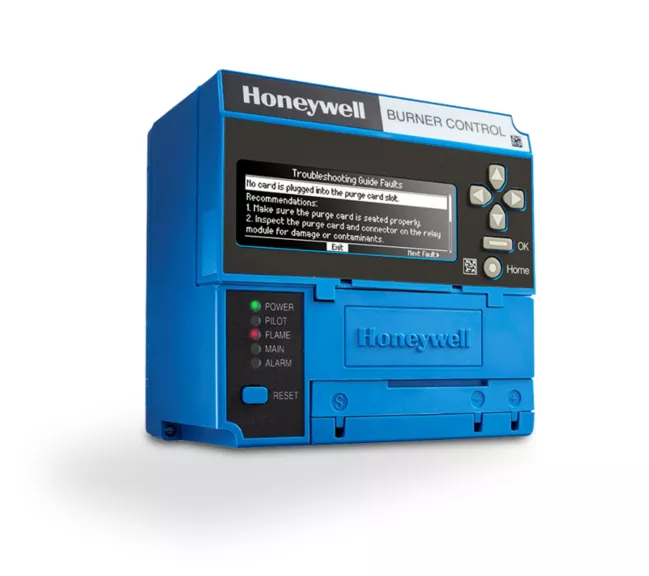
BDC stocks most models of the Honeywell 7800 Series and every Honeywell Slate module. Those are the two platforms we recommend first.
Honeywell Flame Safeguard: 7800 Series
The 7800 handles every single-burner and multiburner industrial combustion application. It also has a large install base. You will find it in most industrial facilities that run burners, so your maintenance team has likely worked on one before.
The display
The keyboard display module reads faults in plain language. When something trips at 2 a.m., your maintenance team is the first to look at it, and a plain-language readout tells them what failed and whether they can clear it themselves. A coded display sends them hunting for a manual before they can take action.
Modular configuration
Say you install a UV scanner for flame detection and later find the application needs a flame rod, or your runtime changes and you need self-check. On the 7800, that is a module swap and a couple of extra terminals for the scanner. Your existing chassis and wiring stay in place, and the panel schematic holds.
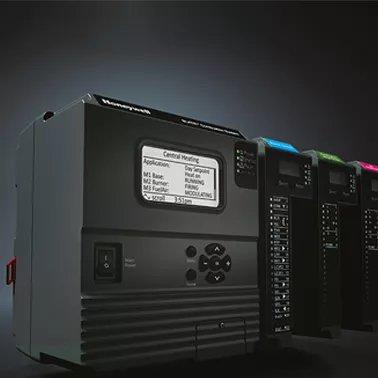
Honeywell Slate
Slate is essentially a 7800 with PLC functionality built in. It adds:
- Troubleshooting annunciation
- Fuel-air ratio control
- Analog and digital I/O
Slate also works with most flame sensing devices, so the detector decisions covered below apply to it as well.
Other Flame Safeguards We Supply and Support
If your facility already runs a different platform, BDC can provide and support any flame safeguard model, including:
- Kromschröder BCU
- Siemens LME
- Fireye
- Eclipse Veriflame
- PCI
Which Flame Detector Should Your Flame Safeguard Use?
A flame detector sits on the burner and sends a signal back to the flame safeguard. That signal is the proof of flame. On the Honeywell units we use, a healthy signal reads around five volts. Signal strength tracks flame quality, so a burner running off-ratio produces a weaker signal, and if it drops below the threshold the flame safeguard shuts the system down even with a partial flame still burning.
There are four types of flame detectors in common use: UV scanners, self-check UV scanners, infrared scanners, and flame rods. Each one suits different applications. Your burner and its environment determine which will work.
UV Scanners
A UV scanner reads the ultraviolet light a flame gives off. When it sees that light, it tells the flame safeguard a flame is present.
A UV scanner mounts on the burner front and views the flame through a sight pipe, so nothing sits inside the flame itself. That makes it the answer when a flame rod will not work: a burner running too hot for a rod, or one without enough metal in the right place to ground one.
A common problem with this style of flame detector is that the bulb inside can fail in a positive state and send false signals back to the control panel. For this reason, standard UV scanners are permitted on intermittent-duty burners and not on continuous operations that leave burners running for days or weeks.
Self-Check UV Scanners
This uses the same sensing technology as the standard UV with a verification routine built in. On an interval, a shutter blocks the sensor, and the device confirms the scanner reports no flame while blocked. A scanner still claiming flame behind a closed shutter has failed, and the system shuts down.
These work better on continuously fired equipment, the furnaces and process heaters that run for days or weeks without cycling off. They are also a good option for extremely high temperatures, above roughly 2,500°F, where other types of detectors start to degrade.
Infrared Scanners
Infrared scanners radiant heat rather than light.
It’s important to avoid IR anywhere the environment can produce a false positive. We commonly run into issues with IR sensors in refractory-lined ovens, because the brick holds heat, and a wall still glowing red after the burner shuts off can read as flame. The detector tells the flame safeguard everything is fine while gas keeps flowing into a chamber with nothing burning in it.
Flame Rods
A flame rod is a metal rod that sits directly in the flame path. AC voltage is sent into the rod, and the flame rectifies it, so DC comes back. The returned signal is physical proof that flame is touching the rod.
That contact is what makes a flame rod a fool proof system for flame detection. It can only fail by burning up, and once it burns up it stops signaling, so the system stays down until someone replaces it.
The only downside is that flame rods aren’t suitable for extremely high temperatures, 2,500°F or above.
Proved Pilot vs Direct Spark Ignition
Knowing which ignition style you have on your system is critical to getting your flame safeguard spec right.
Direct Spark
Direct spark uses one gas line sized for full capacity, with an actuator holding the gas back at low fire. A safeguard in this scenario proves that low fire position through a switch. It opens the safety valves and sparks the igniter, and once it proves flame.
Proved Pilot
Proved pilot uses two gas lines. The main line still proves low fire, but the safeguard opens a smaller pilot valve first and sparks the igniter. Once the pilot is proved and holds for a set period of time, the main valve is opened to light the burner.
The DIY Danger Zone
You can buy a flame safeguard from anywhere but finding the right one and installing it properly is easier said than done, and it’s where a lot of facilities run into trouble. There is a fair amount of configuration required for a flame safeguard because it has to be wired according to your system.
The limit string
Your safety devices wire into a single circuit, one after another, so the circuit stays closed only while every device is satisfied. When any one device trips, the circuit opens and the burner shuts down. That string typically includes:
- High gas pressure switch
- Low gas pressure switch
- Low combustion air pressure switch
- High temperature limit
The flame safeguard has no way of knowing whether all of the safety checkpoints that your particular system requires made it into the string.
Common DIY Installation Mistakes
- Current NFPA compliance requires proof that your combustion air pressure switch changes state when the blower cycles. Often DIYers will run a jumper wire across the switch and take it out of the circuit entirely, and the system will never know the difference. The problem is that you’ll fail inspection or won’t qualify for insurance coverage.
- NFPA also adds requirements on a revision cycle. So there’s a chance that the flame safeguard you buy may need to be wired a bit differently in order to be compliant. This is why it’s best to have combustion experts install your safeguards.
Need Help Finding the Right Flame Safeguard?
Pulling a flame safeguard off a shelf and wiring it in is rarely as simple as it looks. The device has to match your detector and your ignition sequence, hold up to your runtime hours, and land in a limit string that reflects your compliance requirements.
We’re here to help. We build the full flame safeguard system that matches your operating and compliance requirements, and we can periodically check to make sure you’re continuously in compliance.
Need help with your flame safeguard? Get in touch with a burner expert.