How Immersion Tube Burners Work: Types, Efficiency, and Selection
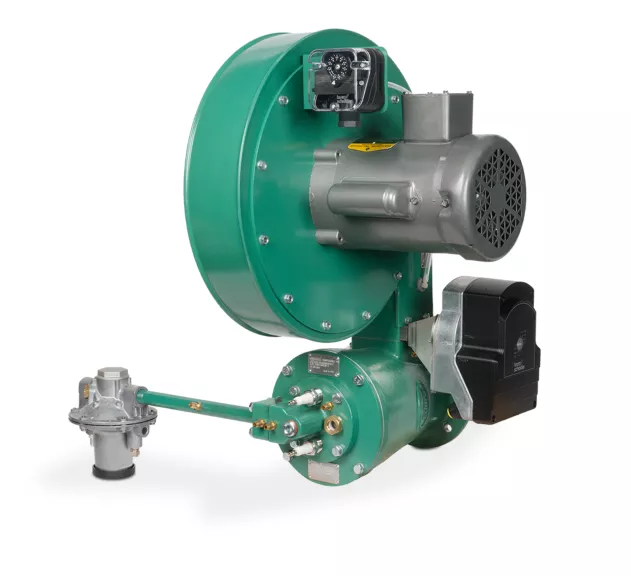
If your facility heats liquids as part of an industrial process, there is a good chance you are running immersion tube burners. They are one of the most efficient methods available for heating industrial liquids, and they are also one of the most misunderstood. Improper burner selection, poor tuning, or simply using the wrong burner type can lead to tube damage, inconsistent process temperatures, and costly downtime.
This article covers how immersion tube burners work, the three main burner types, and what drives the right selection decision. For troubleshooting guidance and maintenance best practices, see this article: Immersion Tube Burner Problems: Common Issues and How to Diagnose Them.
What Is an Immersion Tube Burner?
An immersion tube burner heats liquid by firing a burner down a hollow tube that is submerged inside a solution tank. The tube transfers heat to the surrounding liquid without any direct contact between the combustion process and the liquid itself. Think of it as the most efficient way to introduce heat from a burner into a tank.
The tube typically takes a U-shape, running down one side of the tank and back up the other. In tanks with space constraints, the tube may make multiple passes in an S or W configuration to fit the required tube length within the available footprint. The exhaust exits through the same end or the opposite end of the tank depending on the tube configuration, then turns 90 degrees and exits vertically through the roof of the building.
Immersion tube burners are distinct burner types engineered to produce a specific flame geometry. Choosing the right one for your application is critical to ensuring sufficient, reliable heating for your process.
How the Flame Geometry Works
This is where immersion tube burners differ fundamentally from other industrial burner types, and where getting it wrong causes the most problems.
A standard industrial burner is designed to produce a short, intense flame which isn’t what you want in an immersion tube. A short, hot flame would concentrate all of its heat at the front of the tube, creating a hot spot near the burner flange while leaving the rest of the tube underperforming. Over time, that hot spot can warp the tube or even burn a hole through it.
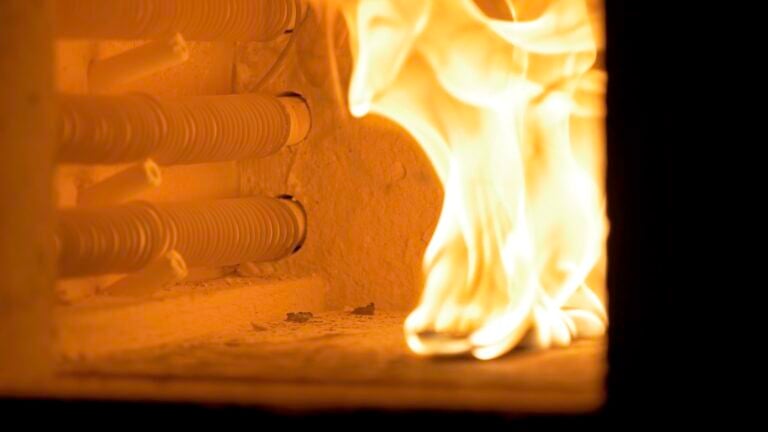
Immersion tube burners are specifically engineered to produce a long, spiraling corkscrew flame. The goal is to spread heat as evenly as possible along the full length of the tube, which improves both efficiency and tube longevity. The longer the flame travels down the tube, the more uniform the heat distribution.
This flame geometry is only achieved when the right burner type is in place and that burner is properly tuned. When burner tuning drifts, the flame reverts toward a short, direct pattern, and efficiency can fall below 50%.
The Two Immersion Tube Burner Types
Immersion tube burners fall into two categories, defined by operating pressure and tube diameter. BDC carries both.
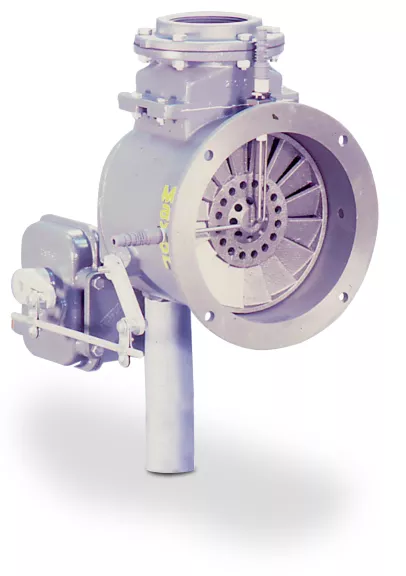
1. Low Pressure / Large Diameter Tube — Maxon Tube-O-Flame
The Tube-O-Flame achieves the corkscrew flame through low velocity and low pressure, producing a long, slow-moving flame that combusts gradually as it travels down the tube. It requires a larger tube diameter per BTU than high-pressure designs, but performs reliably in that configuration.
- Tube diameter range: 6 to 14 inches
- Thermal efficiency: approximately 70–75%
- Best suited for: existing large-diameter tubes, or applications where tube footprint is not a limiting factor
2. High Pressure / Small Diameter Tube — Maxon Tube-O-Therm and Eclipse ImmersoJet
The Tube-O-Therm and ImmersoJet operate on the same principle: higher velocity air through a specialized nozzle and mixing cone that causes the flame to attach to the inner tube wall and spiral forward. Originally competing product lines, both are now carried by Honeywell. Either will perform comparably in the right application.
- Tube diameter: smaller than the Tube-O-Flame for the same BTU output
- Thermal efficiency: approaching 80%
- Best suited for: new installations, space-constrained tanks, or applications where a smaller tube diameter is required
The efficiency advantage of the high-pressure type is real but narrower in practice than the numbers suggest — because the smaller tube diameter means less heat transfer surface area. The gap between the two approaches tends to close when the full system is considered.
Burner Comparison at a Glance
| Low Pressure / Large Diameter | High Pressure / Small Diameter | |
| Burner models | Maxon Tube-O-Flame | Maxon Tube-O-Therm, Eclipse ImmersoJet |
| Tube diameter range | 6–14 inches | Smaller diameter |
| Thermal efficiency | 70–75% | ~80% |
| Flame mechanism | Low velocity, gradual combustion | High-velocity corkscrew nozzle |
| Best for | Existing large-diameter tubes | New installs, space-constrained tanks |
| Key constraint | Larger tube footprint required | Less heat transfer surface area |
Choosing the Right Burner
Selecting the correct immersion tube burner is not simply a matter of matching BTU output. Three factors drive the decision:
1. Tube diameter and length The existing or planned tube size is often the deciding factor. If you have a large-diameter tube already in place, the Tube-O-Flame is the logical choice. If you are designing a new system or replacing a tube and want to minimize tube size, the Tube-O-Therm or ImmersoJet will get you there more efficiently.
2. Required BTU output Each burner type has limits on how much heat it can deliver per given tube size. If you need to increase capacity on an existing system, be aware that simply swapping in a higher-BTU burner is not always straightforward. Increasing capacity often requires a larger tube diameter. You cannot always push more BTUs through the same tube without running into heat flux issues.
3. Heat flux Heat flux is the amount of heat delivered per square foot of tube surface, measured in BTUs per square foot. This number has an upper limit, roughly 20,000 BTU/sq. ft. for properly designed immersion tube systems. Exceeding this threshold pushes efficiency into a range where condensation begins to form inside the tube. Once moisture enters the tube, you get a range of problems: disruption of the flame geometry, CO emissions from water vapor, and audible rumbling or rattling in the tube caused by water in the combustion path.
Need Help with Your Immersion Tube Burner?
BDC’s field service technicians are trained specifically on immersion tube burner systems, including the Maxon Tube-O-Flame, Maxon Tube-O-Therm, and Eclipse ImmersoJet product lines. We help facilities select the right burner for their application, size new installations correctly, and ensure existing systems are configured to run at peak efficiency.
If you are not sure whether your current setup is sized and configured correctly — or if you are evaluating a new installation — contact us for a consultation.